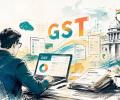
A simplified GST registration facility for small e-commerce sellers, allowing them to register in other states by declaring the e-commerce platform's warehouse as their principal place of business, will be enabled from November 1. This move aims to encourage small businesses to expand beyond their home states.

India's core infrastructure industries recorded a significant growth of 7.9 per cent in September 2026, up from 3.1 per cent in the previous year, primarily fuelled by robust performances in iron ore, electricity, and cement production.

India's Wholesale Price Index (WPI)-based inflation climbed to 12.29 per cent in October, primarily due to increased prices of fuel and power, food articles, minerals, and non-food items, marking a significant rise from September's 11.39 per cent.

The Indian government has permitted Foreign Direct Investment (FDI) in an inventory-based e-commerce model exclusively for the export of domestically manufactured or produced goods, aiming to boost outbound shipments without affecting small local retailers.

Beijing has strongly criticised new US export controls on advanced semiconductor chips to five countries, viewing them as an attempt to prevent diversion to China. This condemnation comes just before US President Donald Trump's visit to Shenzhen for the APEC summit, where geopolitical tensions, including China's opposition to the Quad, are also in focus.

US Treasury Secretary Scott Bessent on Friday faulted the Commerce Secretary Howard Lutnick for stalling the designation of Nvidia client Megaspeed as a potential national security risk, bringing internal Trump administration friction into the open in the wake of Nvidia CEO Jensen Huang's departure.

At the heart of the decision is concern over the survival of Meghalaya's neighbourhood retailers.

India has banned the export of lithium-ion battery black mass with immediate effect to ensure domestic availability of critical minerals and strengthen its battery recycling industry. This move aims to address the underutilisation of domestic recycling capacity due to inadequate feedstock and reduce reliance on imports for essential minerals like lithium, cobalt, nickel, and manganese.

India's wholesale price-based inflation surged to 11.39 per cent in September, up from 9.92 per cent in August, primarily driven by increasing prices of food, manufactured items, and fuel and power.

Nepal Prime Minister Balendra Shah is on a two-day visit to India, focusing on energy, economic cooperation, and infrastructure development. This marks his first official bilateral foreign visit since taking office. Discussions will cover expanding connectivity, trade, and investment, with several MoUs expected to be exchanged. The visit aims to strengthen the deep-rooted ties between the two nations.

Telangana IT Minister D Sridhar Babu stated that Gen Z will be the driving force behind the next wave of AI and green innovation. He urged young innovators to use their skills to solve real-world challenges, particularly in sustainability. The launch of the Green Skills and Applied AI Centre of Excellence in Hyderabad, a partnership between Telangana's IT Ministry, Microsoft, 1M1B, and MeitY Startup Hub, aims to equip graduates with industry-relevant skills in AI, green pharma, solar energy, EVs, and wind energy, with 100 job offers already announced.

The Union finance ministry has constituted a high-level committee, chaired by former Central Vigilance Commissioner Suresh N Patel, to recommend structural, regulatory, and legislative reforms for India's banking sector, aiming to make banks globally competitive and support the financing needs of a developed economy.

Dedicated Ayush dispensaries increased from 26,130 in 2013-2014 to 37,804 in 2024-2025, while hospitals rose much more slowly, from 3,605 to 3,885.

'The political leadership is very clear that we have to move towards the integration of the three services into theatre commands.'

India's wholesale price-based inflation (WPI) increased to 9.92 per cent in August, up from 9.78 per cent in July, primarily due to rising prices across food, manufactured items, and fuel and power sectors.

Trade and business associations across India are organising a 'No UPI Day' on October 2 to protest the upcoming 0.4 per cent merchant discount rate (MDR) on Unified Payments Interface (UPI) transactions exceeding 2,000, effective from October 15.

Engagement with neighbours has gathered pace, particularly as the conflict in West Asia has exposed their vulnerability to energy supply disruptions.

Prime Minister Narendra Modi and US President Donald Trump held a telephone conversation to review progress in bilateral ties, covering trade, defence, and energy, against the backdrop of heightened trade friction due to the 'Lindsey O. Graham Sanctioning Russia and Iran Act of 2026'.

India has initiated anti-dumping investigations into imports of Glycine from China, following a complaint by Avid Organics, alleging material injury to domestic manufacturers. Concurrently, a separate anti-circumvention probe has begun concerning CPVC resin from China and South Korea, suspected of being routed through Malaysia, Japan, and Thailand to avoid existing duties.

The Chintan Shivir is expected to discuss the progress of government schemes, policy implementation, time management, inter-ministerial coordination, and public service delivery, among others.

A Parliamentary Standing Committee on Commerce has urged the Indian government to swiftly conclude the proposed India-US Bilateral Trade Agreement (BTA), while ensuring India's interests are protected, recommending complete exemption for key export products like generic medicines and smartphones from future US tariff increases.

India's wholesale price index (WPI) inflation marginally eased to 9.78 per cent in July 2026, down from 9.87 per cent in June, primarily due to a cooling in the prices of fuel, power, and food items, marking the first month-on-month drop under the new 2022-23 base year.

The Retailers Association of India (RAI) has voiced concerns that the government's new 0.4 per cent Merchant Discount Rate (MDR) on UPI transactions above Rs 2,000 could reverse the progress of digital payment adoption among small retailers. This fee, effective October 15, places the burden on merchants operating on thin margins, potentially pushing them back to cash transactions and undermining the government's formalisation agenda, especially ahead of the festive season.

'Major unions should be included. If this goes on, decision-making will become heavily one-sided and we will be forced to continue our strikes.'

The United Arab Emirates (UAE) has expressed intent to invest an additional $25 billion in India, with an ultimate goal of reaching $100 billion in investments, Union Minister Piyush Goyal announced. This comes as both nations plan to enhance cooperation in shipping, ports, energy, and emerging technologies, against a backdrop of expanding bilateral trade.

India has attracted foreign direct investment (FDI) worth approximately 4,896 crore across 29 projects since May, following the government's relaxation of norms under Press Note 2 of 2026. The revised rules permit investment without government approval from entities with up to 10 per cent non-controlling ownership by land-bordering countries.

Industry bodies representing alcoholic beverage manufacturers have welcomed the India-UK Free Trade Agreement (FTA), which will see tariffs on UK whisky and gin reduced, boosting bilateral trade and supporting premiumisation. However, domestic manufacturers are calling for state governments to withdraw concessions currently enjoyed by imported liquor brands.

India's proposal to link BRICS payment systems, including central-bank digital currencies (CBDCs), was notably absent from the grouping's New Delhi Declaration, despite being a key agenda item for India's chairmanship. This omission leaves the 16-year effort for trade in local currencies without a settled payment architecture, with the declaration only 'acknowledging' the work of the BRICS Payment Task Force.
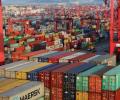
The country's goods and services exports have crossed $820 billion in 2024-25, marking a nearly 6 per cent increase over the previous fiscal year despite global economic uncertainties, the commerce ministry said on Wednesday. The exports stood at $778 billion in 2023-24.

'You have to get private investment to somewhere between 35% to 36% of GDP. It is hovering about 30%-31%.'

Finance Minister Nirmala Sitharaman stated that India is likely to sustain economic growth of 7 per cent or more in 2026-27, continuing the pace recorded since the Covid-19 pandemic, despite geopolitical uncertainties and supply-chain disruptions.

"Indian Railways is now the world's second-largest cargo carrier by volume, up from fourth, even as its share of the country's total freight movement remains well below potential.'

'Wages have not risen. Rural wages have stagnated. The growth was 0.7 per cent last year. For casual and irregular labour, the wage growth is negative.'

India has strongly refuted claims by the United States Trade Representative (USTR) regarding excess capacity in its steel and textile sectors, arguing that the nation's significantly low per capita consumption of these products contradicts such assertions, according to Amitabh Kumar, Additional Secretary in the Ministry of Commerce.

The National Financial Reporting Authority (NFRA) has commenced an investigation into Rajesh Exports concerning a 15.15 trillion financial misstatement, following a referral from market regulator Sebi.

Guests at President Droupadi Murmu's Independence Day 'At Home' reception will be welcomed with handwoven Maheshwari stoles, celebrating the vibrant art traditions of Chhattisgarh, Goa, Madhya Pradesh, and Maharashtra, alongside an invitation package highlighting sustainable environmental practices.

India has launched anti-dumping investigations into imports of thermal paper, Biaxially Oriented Polyamide (BOPA) Film, and certain antioxidants from China, following complaints from domestic manufacturers alleging material injury due to cheap imports.

India's wholesale price inflation (WPI) increased to 9.87 per cent in June, up from 9.68 per cent in May, primarily due to significant price increases in non-food and food products, with food inflation alone rising to 5.49 per cent.

India's wholesale price index (WPI) inflation surged to 9.68 per cent in May, up from 8.26 per cent in April, primarily due to significant increases in the prices of fuel and power, manufactured goods, and food items.

Another priority in the first 100 days could be the launch of an e-platform -- Trade Connect -- to help exporters connect with stakeholders of international trade.
